Quick Answer
Choosing a concrete batching plant should not be based only on model name or theoretical capacity. A reliable selection should consider required output, continuous production time, application, aggregate supply, powder storage, site layout, vehicle movement, power conditions and final project configuration.
Industry Context
Concrete batching plants are widely used in ready-mix concrete production, construction projects, infrastructure work and concrete supply operations. As project requirements become more specific, buyers increasingly need equipment recommendations that match real operating conditions rather than generic model comparisons.
Capacity Is Only the Starting Point
Many buyers begin with a simple question: “How many cubic meters per hour do I need?” This is useful, but it is not enough. The target hourly output or daily concrete demand should be reviewed together with expected working hours, project cycle, material supply and site management conditions.
Theoretical Capacity Has Clear Limits
Theoretical capacity is usually calculated under defined technical conditions. For example, if one cycle produces 3 m3 and the cycle time is 60 seconds, the theoretical output is 3 x 3600 / 60 = 180 m3/h. This is a calculation under ideal continuous operation, not a guaranteed actual site output.
Actual Output Depends On The Project
Real production can be affected by aggregate loading, cement supply, batching rhythm, operator coordination, truck availability, discharge timing, maintenance status and site organization. For this reason, professional equipment planning should distinguish theoretical capacity from practical production expectations.
Configuration Shapes Performance
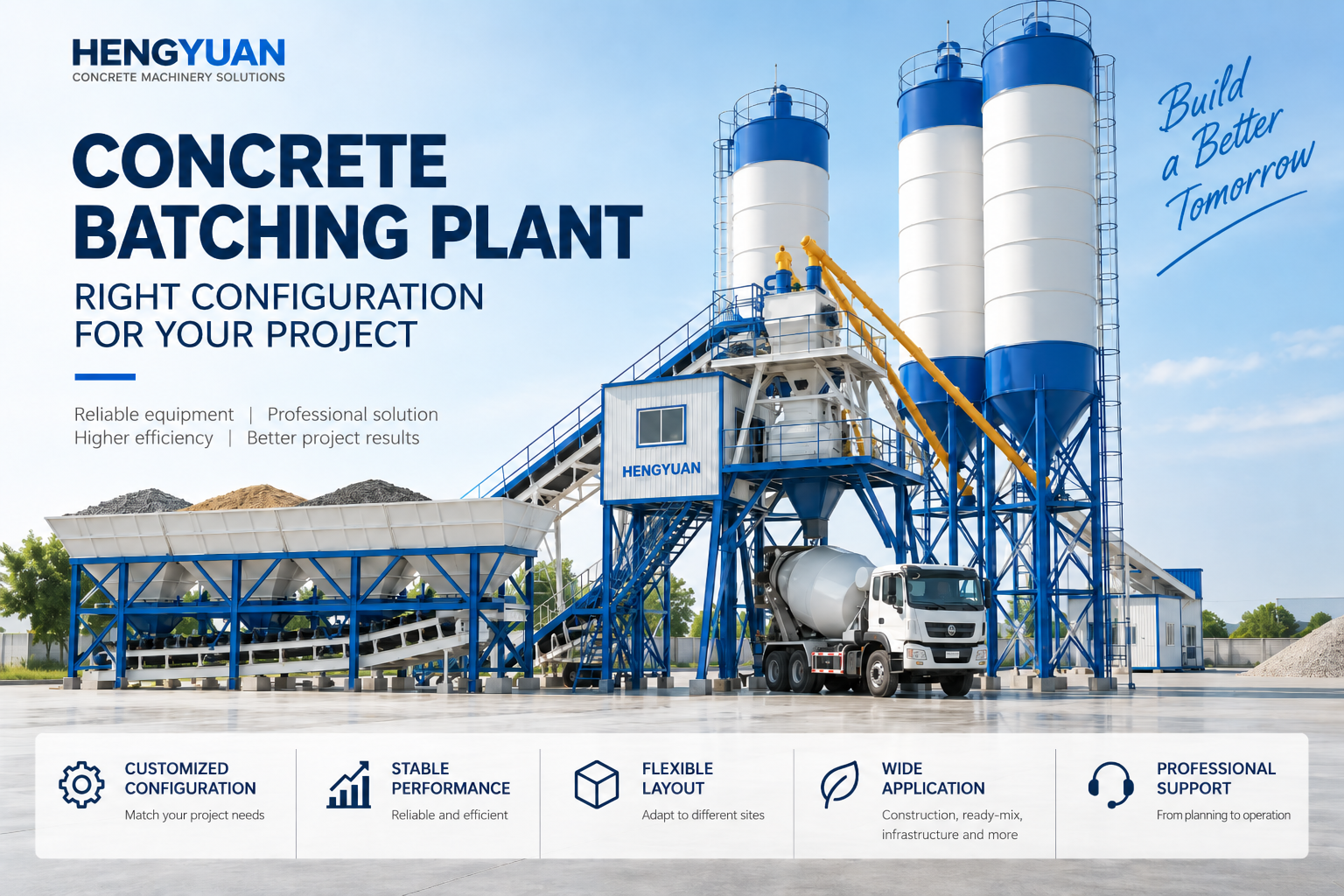
A concrete batching plant may involve aggregate batching, aggregate feeding, the main mixer, powder and cement systems, water metering, additive metering, pneumatic systems, control systems and discharge systems. However, these should be treated as configuration-related systems, not as a universal checklist for every plant.
Skip Feeding And Belt Feeding
Aggregate feeding is one of the most important layout decisions. In comparable batching plant projects, skip or hopper feeding is often more space-saving than belt feeding. This does not mean skip feeding is always better, or that belt feeding is always required for larger projects. The final choice depends on capacity, site space, material yard layout and workflow.
Site Layout Comes Before Final Selection
Before recommending a plant layout, buyers should confirm available site dimensions, aggregate storage location, vehicle entrance and exit routes, turning space, powder silo position and loader operating path. These details help determine whether the plant can operate smoothly after installation.
Powder Silo Planning Needs Project Data
Powder silo quantity and capacity should not be selected by model name alone. A project should first confirm the powder materials to be used, such as cement, fly ash, mineral powder or other powders, and identify which materials require independent storage.
Replenishment And Storage Conditions Matter
Powder silo planning should also consider expected consumption, delivery frequency, transport conditions and on-site storage limits. A fixed silo number or fixed capacity may look convenient, but it can lead to a poor match if the project’s material flow is different.
Electrical Conditions Must Be Confirmed
Before quotation and technical confirmation, the actual installation site power conditions should be checked, including voltage, frequency and phase. Electrical compatibility should be confirmed through the final technical solution, not assumed before project verification.
Buyer Questions Should Be Specific
A useful inquiry should include target capacity, daily demand, working hours, concrete application, project location, aggregate situation, powder materials, site size, power conditions and any installation restrictions. The more specific the information, the more accurate the equipment recommendation can be.
Supplier Role In Project Planning
Hengyuan is positioned as a construction machinery supplier focused on concrete-related equipment, including concrete batching plants, concrete mixers, concrete pumps and stabilized-soil mixing plants. Product recommendations should be based on verified model information and project-specific technical confirmation.
Practical Selection Principle
The best batching plant is not simply the biggest model or the lowest quoted price. It is the plant configuration that fits the customer’s production target, site conditions, material supply, installation requirements and long-term operating needs.
Conclusion
For concrete batching plant buyers, the key is to move from “Which model should I buy?” to “Which configuration fits my project?” A careful review of capacity, layout, materials, feeding method, powder storage and electrical conditions helps create a more reliable equipment plan and a clearer basis for quotation.